Monday, November 1, 2010

How can "content" help you promote your business?

"Content marketing" (also known as "information marketing") involves using editorial material -- articles, podcasts, videos, white papers, newsletters, etc. -- to deliver high-quality, relevant, and valuable information to your target audience. It's a common marketing practice. According to Junta42's 2010 Content Marketing Spending Report, 59% of marketers planned to spend more on this strategy in 2010. Junta42 also reports that the average business marketer spends 33 percent of its marketing budget on creating content and getting it out there to customers and prospects.

Why are they spending money on making useful, helpful information available online and elsewhere for free? Here are a few reasons:
  1. It helps position them as the experts in their fields.
  2. Prospects discover that the information source is the best resource for the product or service they're researching (and customers are reminded of this).
  3. It generates Web site traffic because of the impact information has on search engine rankings -- and Web site traffic can lead to sales.
  4. It helps educate.
  5. The online exposure generates publicity when journalists discover that an individual or business shows up consistently in search engine queries
The U.S. Postal Service's free marketing magazine, Deliver, is a great example of how a large organization embraces and implements content marketing (disclaimer: I'm a regular contributor to the magazine and its companion Web site). Deliver educates marketers about the various USPS products and how to use them wisely while providing best practices, case studies, and ideas about how to create successful direct mail campaigns. Wells Fargo does the same thing for small businesses (I've contributed to their content marketing as a writer, too), providing free how-to information designed to encourage trust.

Content marketing is simple and easy. All you do is share what you know. It's a smart strategy that can be easily impletmented by organizations of all sizes. In fact, it's easier for entrepreneurs and others in smaller organizations to do this because there's less of a distance between the person with the information that has to be shared and the person who turns it into shareable content. (In many cases, they're the same!) And with fewer layers and less bureaucracy, it takes less time to approve and share the content, whether it's an article, video, audio interview, booklet, or special report.

Here are a few examples of how I use content marketing for my small business:
There's a lot more I need to know about this topic . . . and when I need to learn something, I find someone to teach me. In this case, you get to learn, too! On November 15, I'm hosting a teleseminar with content marketing expert Stephanie Chandler. She's going to be talking about how this topic relates to book marketing, but her information and concepts can be applied to any type of organization, product, or service. (Learn more here.) I'm looking forward to asking her the questions that will get you the information you need to begin using content marketing. Look online for more information, too -- the companies that provide content marketing services are, of course, good about providing free information about this strategy!

How do you use content or information marketing in your business?

Tuesday, October 19, 2010

Chilean miners get media training...should you?

I love that the Chilean miners received media training while still in the mine. We should all be this prepared before we face the press, right? Anyone who hopes to be interviewed by the media -- whether it's because of a crisis or a whizbang new product launch or the next best-seller -- should get some practice in front of a microphone before heading into the media glare.

How much training you get and who provides it depends on your budget and location. Business people, authors, and nonprofit leaders in major metropolitan areas can work with a local consultant who specializes in preparing people for media interviews. Google "media training" and your city for a list of consultants.

Those in smaller markets usually don't have access to these specialists, but can still do well working with a local public relations (not advertising) firm. Make sure you ask who and how many they've trained before and check references. Also consider hiring a local TV newscaster to moonlight for you. Veteran broadcasters know what questions you'll get asked, how they'll be asked, and what a good answer sounds like. Like consultants, local broadcasters can coach you in how to react and respond, how to speak in sound bites that will make sure your interview gets used, and what to avoid saying.

The miners were smart enough to get help. Learn from their experiences and line up your trainer now.

Have you received professional media training? How did it help you?

Friday, October 15, 2010

5 common Facebook faux pas

Do you make any of these social networking mistakes? We're all guilty of Facebook faux pas from time to time. It's only when we repeat them continually that we run the risk of being unfriended. Here are some of the mistakes I see regularly and why they're a problem:
  • Being ridiculously self-promotional. Several colleagues at a recent meeting said this was their biggest Facebook pet peeve.  I can relate. A few weeks ago, I received a Facebook invitation from someone who included a promotional message with her friend request. I thought that was odd, but gave her the benefit of the doubt and accepted the request. This was followed by a similar advertising message from her on my wall: "I'm glad we're friends. I think you'll be interested in my product X and my service Y." It's not the best way to start a relationship -- in social networks or in face-to-face networks. 
  • Writing "happy birthday!" to someone on your own wall. OK, this is funny when my Mom does it, but when the rest of us do it, it's kind of silly. Here's how to avoid this: Go to your home page. Under "Events" in the upper right, you'll see the names of any Facebook friends with birthdays today. Click on the name; that will take you to the birthday girl's page. Write your message on her wall.
  • Saying something mean on a wall that you wouldn't say to someone's face. AWKward. This gives us too much insight into your true character. Ick.
  • Writing private messages on your friend's Facebook wall. These messages make the rest of us uncomfortable. It's like we're eavesdropping. Use the Facebook e-mail system instead. Here's how: Go to your friend's profile page. Under his picture, you'll see "Send (name) a message." Click on that and you'll get an e-mail window.
  • Sending "you should 'like' this page" messages to all of your friends rather than sending it only to people who might actually be interested in the business or product. If you're in Michigan and the page you "like" is for a local business, don't send the "I like this page and I think you will too" message to your friends in other parts of the country. Keep it local. (This applies even if you're paid to do this for clients.) Most people don't mind occasional irrelevant messages, but when you do it a lot, you're going to lose friends. (And maybe that's not a bad thing.)
I like how Facebook lets us be our own forum moderators. Let's help these people out by taking advantage of our ability to be in control of our own content. When someone writes something on your wall that's better suited to a private conversation, delete it. (Move your mouse to the end of the first sentence. The word "REMOVE" appears. Click it.). Then respond to the question or comment through your Facebook e-mail inbox -- it's a quiet way to suggest the right way to handle sensitive or private topics. Similarly, when someone writes something on your wall that makes you uncomfortable, delete it, because if it bothers you, it will bother someone else, too.

What's the most common Facebook faux pas you've seen? Tell us!

Monday, October 4, 2010

Author explains how to create sound bites that resonate

resonate: Present Visual Stories that Transform Audiencesresonate: Present Visual Stories that Transform AudiencesThe following information is excerpted from a press release I received today. The tips for creating memorable sound bites apply to media interviews, presentations, and written communications materials. This is a topic we've covered here before (see this posting on how to create compelling sound bites) because it's important. Talking to the press is a waste of your time -- and theirs -- if what you say doesn't get used. Here are Nancy Duarte's tips for making sure you offer memorable sound bites:

At a time when people are tweeting, blogging, e-mailing, and more 24/7, the best way to genuinely connect and create change, says author and CEO Nancy Duarte, is via truly human, in-person presentations. She stresses that everyone in every company should know how to present and communicate that company's messages with clarity and passion.

"Great presentations are like magic," says Duarte, CEO of Duarte Design, author of the new book Resonate: Present Visual Stories That Transform Audiences.
 
"It takes a lot of work to breathe life into an idea. Spending energy to understand the audience and carefully crafting a message that resonates with them means committing time and discipline to the process. Think about it this way: You likely spend countless hours collaborating and innovating to put forth really good ideas. You should spend just as much energy ensuring they are delivered in a way that is impactful. The payoff is that learning how to present in a captivating way—be it at a formal event or to a client across the conference room table—can be your competitive edge in a business environment where too many companies are confusing communication with noise."

Just as Duarte's first book, Slide:ology, helped presenters become visual communicators, Resonate helps presenters make a strong connection with their audiences and lead them to purposeful action. The book is simultaneously an explanation, a how-to guide, and a business justification for story-based messaging. It will take you on a journey to a level of presentation literacy that very few have mastered.

So how can you make sure you present information in a way that truly resonates?

"If people can easily recall, repeat, and transfer your message, you did a great job conveying it," says Duarte. "To achieve this, you should have a handful of succinct, clear, and repeatable sound bites planted in your presentation that people can effortlessly remember. A thoroughly considered sound bite can create a 'Something They'll Always Remember (S.T.A.R.)' moment—not only for the people present in the audience but also for the ones who will encounter your presentation through broadcast or social media channels."

To help you get started creating presentations that really stick with your audiences, here are a few tips on how you can incorporate repeatable sound bites: 
  • Create crisp messages. Picture each person you speak to as a little radio tower empowered to repeat your key concepts over and over. "Some of the most innocent-looking people have fifty thousand followers in their social networks," says Duarte. "When one sound bite is sent to their followers, it can get re-sent hundreds of thousands of times."
  • Craft a rally cry. Your rally cry will be a small, repeatable phrase that can become the slogan and rallying cry of the masses trying to promote your idea. President Obama's campaign slogan, "Yes We Can," originated from a speech during the primary elections.
  • Coordinate key phrases with the same language in your press materials. For presentations where the press is present, be sure to repeat critical messages verbatim from your press materials. "Doing so ensures that the press will pick up the right sound bites," explains Duarte. "The same is true for any camera crews who might be filming your presentation. Make sure you have at least a fifteen- to thirty-second message that is so salient it will be obvious to reporters that it should be featured in the broadcasts."
  • Use catchy words. Take time to carefully craft a few messages with catchy words. "For example, Neil Armstrong used the six hours and forty minutes between his moon landing and first step to craft his historic statement," says Duarte. "Phrases that have historical significance or become headlines don't just magically appear in the moment. They are mindfully planned."
  • Make them remember. Once you've crafted the message, there are three ways to ensure the audience remembers it: First, repeating the phrase more than once. Second, punctuating it with a pause that gives the audience time to write down exactly what you said. And finally, projecting the words on a slide so they receive the message visually as well as aurally.
  • Imitate a famous phrase. "Everyone knows the Golden Rule," says Duarte. "'Do unto others as you would have them do unto you.' Well, an imitation of that famous phrase might be 'Never give a presentation you wouldn't want to sit through yourself.'"
 To learn more about the author's work, visit http://www.duarte.com/.

Tuesday, September 21, 2010

Message development: 6 steps to creating messages that make a difference

Message development is an essential step in your publicity planning process and yet, many of us forget to spend any time being thoughtful and strategic about what we want to say when we're interviewed by the press. You've heard the cliche: "Failing to plan is planning to fail." That's especially true with media interviews. How will you make sure you communicate the key points about your project, mission, product, service, book, organization, whatever if you haven't given careful thought about what you really need to get across in your precious time with that journalist?
If you aren't clear about your messages each time you communicate with the media, your publicity will be less effective. Message development for all types of businesses and organizations involves six steps:
  1. Define the issue. Take into account what your audience knows about the topic and what you bring to the discussion. What makes you different, special, better with regards to the issue or topic? Gather any relevant statistics, too -- you might need them to help make your point.
  2. Create draft messages. Brainstorm possible messages, but remember: You want messages that resonate with your audience, not your staff. That's why knowing your audience -- and what they do and don't know about the topic -- is important.
  3. Test draft messages. Don't test them in the workplace. Try them out on people you want to influence. Listen carefully to their responses and take their input seriously.
  4. Refine the messages. What language seemed to resonate with the people in your test or focus group? What language confused them? Where did they get confused? Take all of this into account...and try again.
  5. Test again. The repeat testing is important because you want to be certain that your key messages are appropriate and can influence the behavior you're looking for.
  6. Adjust again. Keep making changes -- and testing -- until you're confident that you're using language that will generate the reaction you want.
As you work on your messages, make sure they:
  • Contribute to your goals.
  • Resonate with the people you want to influence -- even if this means they don't resonate with you.
  • Get used in interviews in some form. If they don't, work on them some more.
Once your messages are final and you're confident they communicate what you want them to, work them into media interviews, press releases, Web site text, social media communications, marketing materials, etc. You might need to massage them to meet the needs of these different communication vehicles, but stay as true as you can to the language because you know it works.

What's the best message you've seen?

Wednesday, September 15, 2010

Word of mouse: 10 ways to master nonprofit guerrilla social media


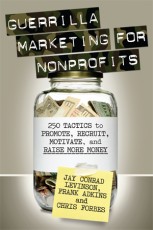
My guest blogger today is colleague Chris Forbes, co-author of Guerrilla Marketing for Nonprofits. Chris and I met in the virtual world several years ago when he reviewed my two publicity books on his blog. I'm now happy to reciprocate, putting a spotlight on his book (I like it so much that I provided a "blurb" that appears on the inside).

Chris writes here about social media for nonprofits, but his ideas can apply to small businesses, solo-preneurs, authors, and others. Here's what he has to say:

Guerrilla marketers know a good deal when they see one. And social media is a very good deal for guerrillas because they focus on reaching individuals instead merely selling their ideas to markets. With a little time, energy, and imagination, nonprofit guerrillas deepen their relationships with their clients and supporters and increase the frequency of exposure of their message to the people they want to reach by using social media. To get the most out of social media, it is important to make strategic use with a plan. Below are 10 ways your organization can master the use of social media.
  1. Message: In order for your message to have any impact for your cause, it has to contain your message. A funny or interesting video, even if it becomes a very popular online phenomenon, is useless to your nonprofit if it doesn’t get people to take action.
  2. Meme: The message of your viral outreach needs to be easy to grasp without explanation and easy to pass on to others.
  3. Meeting: Find the media that your target audience likes to use and go where the people are. Media researchers estimate 60 percent of adults belong to a social network, but most only belong to one. Spread your virus in a variety of networks.
  4. Manage: Funnel the contacts you make in social media toward your Web site or blog. Make your Web site the second tier of your social media strategy. The third tier is when people register with your site. Mobilize the people who sign up on your site to take action and help spread the message.
  5. Material: Give people the content they need to pass along your viral marketing. Provide assets for your audience to make their own videos, allow them to put their picture in an e-card, do anything that helps to put themselves into the story line and send to their contacts.
  6. Mobilize: Make it easy to pass your content through word-of-mouse. Choose the video tools that allow you to embed your videos directly into Facebook, blogs, etc. Social bookmark tabs need to post you link and teaser copy into other sites.
  7. Medium: Make your content a good match for the medium. Long videos will not be watched as much as shorter ones. Break up paragraphs in articles and write lead sentences remembering they may also serve as the teaser copy for the links when they are visible on other sites.
  8. Marketing: Your content needs to have links back to your sites and copy that promotes your organization. Don’t leave the “More Info” section blank; include good copy using your key words and links.
  9. Metrics: Watch the statistics. Check not only how many people view, forward, or tweet your content, but track how many click through and take the next step with your message, too.
  10. Momentum: Start the ball rolling by forwarding your content to the networks of your intended target. Leave room in tweets for people to “re-tweet” (RT). Prime the commenting by starting the first comment on links and posts you put in other networks. Push your virus into new networks until it takes off on its own.
What's the most effective social media tactic you've used? Why do you think it worked?

Wednesday, August 25, 2010

How to announce your book with an e-mail blast

What’s the best way to announce your book via e-mail?
I’ve received quite a few book announcement e-mails lately, including some that were trying to achieve “Amazon best-seller” status. Sadly, most of the messages were not very compelling. More often than not, they were self-congratulatory (“I’ve achieved my dream!”) or self-serving (“If you buy my book on Amazon at 11 a.m. tomorrow morning, my book might become a best-seller!”). Some were brief: “My new book is out. Here’s a link where you can buy it.” Others were rambling. None of them told me why I’d want to buy the book – what was in it for me, the reader.
I don’t want you to repeat the mistakes I keep seeing in my inbox, so I’m sharing seven tips that will help authors with any level of marketing experience write a book announcement e-mail message that isn’t obnoxious, annoying, offensive, or downright sad :
  1. Start with the text from your back book cover. It should tell us why we will want to buy your book, right? You might need to massage it to make it more personal, since e-mail is such an informal means of communicating.
  2. It’s not about you. It’s about the person you’re writing to. Tell me what your book will do for me. Will it educate, inform, entertain, enlighten? What’s in it for me? How will your book improve my world, help me improve someone else’s world, or help me forget about my world?
  3. Include a link where we can purchase the book. Seriously – you’d be surprised at how many messages omit this.
  4. Forget the “help me make my book an Amazon best-seller” plea. Unless you are my total BFF, I don’t care if your book is a best-seller. All I want to know is whether I’ll like or need your book or whether I know someone else who would like it. If you feel compelled to be focused on that best-seller-for-five-minutes-on-Amazon plan (and my newsletter readers know how I feel about these campaigns), at least share information about your book, too.
  5. Don’t come on too strong. You might suggest that it makes a nice gift, but don’t tell me that I “should” buy it for everybody on my holiday gift list. 
  6. Ask me to share your news with my networks. If I know people who will want to know about your book, I’ll help spread the word. But sometimes I need to be reminded.
  7. Remember that the quality of your announcement reflects the quality of your book, so make it as high-quality as you can. I received one this week that looked like a ransom note, with multiple fonts and sizes. And I know this wasn't what the author intended. You don't need to have a professionally designed, all-HTML'd-up message, but you do want something that reflects the quality of your book.
Send your announcement to as large a list as you can assemble, remembering that some people will be more interested in this news than others. And some are just naturally better at sharing and forwarding. And whatever you do, make this just the starting point for your book launch. There's lots more you could -- and "should" -- be doing.

Have you ever purchased a book based on an e-mail blast announcement? Why?